

Table of Contents
Buying a first fishing kayak gets confusing fast. A lot of reviews rank boats by top speed and rocker profile, numbers that mean nothing if you have never sat in one.
What actually matters when you are new to this is simpler:
- Can you get in and out without going for a swim?
- Will it carry a tackle box and a small cooler?
- Can you get it on top of your car by yourself?
I have fished from a sit-on-top for six seasons now and have gone back and forth between a hard shell and an inflatable depending on where I was living. So here is how I would actually sort these three.
How the Three Compare
Before the details, here is how they stack up side by side.
| Kayak | Best For | Key Spec |
|---|---|---|
| Sun Dolphin Bali SS | A solo paddler on a tight budget | 44 lbs, rated to 250 lbs |
| Sevylor Coleman Colorado | Two anglers with nowhere to store a hard hull | Inflatable, rated to 470 lbs |
| Lifetime Sport Fisher Angler Tandem | A parent fishing with one or two kids | Rated to 500 lbs, 3 rod holders |
The Three Kayaks Worth a Look
None of these calls below come from me personally paddling all three side by side on the same lake.
They come from the published specs plus what owners report after a season or two of real use, and I say that plainly instead of pretending otherwise.
Sun Dolphin Bali SS

This is the Sun Dolphin Bali SS, a rotomolded single-seater. At a glance:
- Material: UV-stabilized Fortiflex high-density polyethylene
- Weight: about 44 pounds for the 10-foot version, light enough to lift onto a car roof rack alone
- Size: 120 x 13 x 30 inches
- Colors: six
- Capacity: 250 pounds, not the higher number some listings float around
Keep yourself and your gear under that 250 with room to spare.
The flat, wide hull is what makes it feel steady the moment you sit down. That same shape is why it moves slowly through the water and gets pushed around by wind on open lakes.
Heads up: there is no scupper plug in the seat-area drain hole, so water backs up through it and leaves your seat damp. A cheap rubber scupper plug or a clip-on seat pad fixes that for under 40 dollars.
The Portable Accessory Carrier that comes with it works as a backpack or a tow-behind, handy for hauling it from the parking lot to the water.

Worth it for:
- The lowest price of the three by a wide margin
- A hull that is genuinely hard to tip while sitting still, good for a nervous first paddle
- Light enough for one person to car-top without help
Skip it if you fish big, windy lakes or paddle more than a mile or two at a stretch.
The flat hull that makes it so stable is also what makes it slow and hard to hold a line in a crosswind, and you will notice that on any real crossing.
Sevylor Coleman Colorado
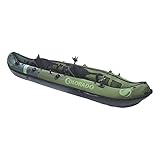
The Coleman Colorado is the inflatable of the group. At a glance:
- Build: 18-gauge PVC with a heavier 1000-denier tarpaulin floor and an 840-denier nylon cover over the top for puncture resistance
- Seats: two
- Capacity: 470 pounds
- Included: Berkley Quick-Set rod holders already mounted, a mesh cargo net, and D-rings for lashing down a crate or cooler
- Valve: a twist-open Boston valve, which you can blow into by hand in a pinch, though nobody wants to do that for a boat this size
Here is the catch owners bring up again and again: no pump and no paddles are included, despite what some listing photos suggest. Budget another 25 to 40 dollars for a double-action hand pump if you do not already own one.
The upside of an inflatable is storage. It rolls down into the included carry bag small enough for a closet shelf or a car trunk, which matters if you are in an apartment with no garage or roof rack.
It also accepts a trolling motor mount if you want to add one later.
Worth it for:
- Fitting two anglers and gear without buying two boats
- Storing flat in a closet instead of taking up garage space
- A 470-pound capacity that covers most two-person setups with a cooler
Skip it if you cannot commit to ten minutes with a pump before every trip, or if you fish open water that gets choppy in the afternoon.
Multiple owners report the flat inflatable hull weathervanes and gets shoved around once the wind hits 10 to 15 mph. This one is best kept to calm mornings and protected coves.
Lifetime Sport Fisher Angler Tandem

This one is rotomolded, UV-protected LLDPE, 10 feet long, and rated to 500 pounds.
The two padded backrests move between three seating positions. So it genuinely works for two adults or one adult and a couple of kids, not just on paper.
Fishing features include:
- Three flush-mounted rod holders
- A 6-inch hatch with a ditty tray for small tackle
- Shock cord rigging up front for extra gear
- Molded paddle cradles that actually hold the paddles in place, instead of the loose bungee loops cheaper boats use
- Two paddles included
It is a wide, heavy hull built for calm lakes and slow rivers rather than speed. Being a tandem kayak, it is noticeably harder to car-top alone than the other two on this list.
If you are loading and unloading by yourself every trip, that is worth factoring in before you buy.
Worth it for:
- The highest weight capacity of the three
- Storage and rigging built specifically for fishing rather than added on
- Being the only one of the three that comfortably fits a second paddler
Skip it if you fish solo.
You would be paying for, storing, and hauling around capacity you will never use. And without a second person to help carry it, loading it onto a rack by yourself gets old fast.
Common Questions
A few questions come up every time this topic gets discussed, so here they are with straight answers.
Should a beginner buy a short or long kayak
Shorter kayaks, in the 10-foot range like all three here, turn easier and feel more stable sitting still. That is what a first-timer usually wants.
Longer kayaks track straighter and cover distance with less effort, but that trade only pays off once you already know how to handle a boat.
Sit-in or sit-on-top, which is better for fishing
For fishing specifically, sit-on-top wins for most people:
- You can get on and off the sides without flooding the cockpit.
- It self-drains through the scupper holes.
- There is room to twist around and cast or land a fish.
Sit-in kayaks sit lower and handle cold or rough water better. But they are a worse fit for a beginner who is still learning to fish from a boat at all.
How do I know if a kayak will feel stable before I buy it
Look at the beam width.
- Close to 30 inches or wider (which covers all three kayaks above): gives you what paddlers call primary stability, meaning it feels planted while you sit still. That is exactly what most beginners are actually worried about.
- Narrower kayaks: trade that away for secondary stability, meaning they feel tippier at rest but handle waves and speed better once you are used to them.
If a shop near you runs demo days, sitting in one for ten minutes tells you more than any spec sheet.
Do I need to upgrade the accessories that come bundled in
The factory rod holders on all three are fine as is.
The one thing worth upgrading early is the paddle. When one is included at all it is usually heavy aluminum, and after a couple of hours that extra weight shows up in your shoulders.
A lighter fiberglass paddle in the 30 to 50 dollar range makes a longer day noticeably less tiring.
Which One I Would Actually Buy
- Fishing mostly alone on smaller water: if I only had one boat to own, the Bali SS is the easy pick for the price.
- Storage space is the real constraint: the Coleman Colorado solves that problem and nothing else on this list does.
- A kid or a partner is coming along: the Lifetime Sport Fisher Angler Tandem is worth the extra size and the harder load-in.
None of these are the last kayak you will ever own. They are the one that gets you on the water this season without a huge outlay, and for a beginner that is the whole point.
If you end up on the Bali SS, it is also worth a look at how to store and protect a kayak once the season winds down.
And if fishing from any of these is new to you, these kayak fishing tips cover the basics worth knowing before your first trip.
Some product links in this article are affiliate links, which support the site at no extra cost to you.


