

Table of Contents
Every gear argument in ultralight backpacking gets to the stove eventually. You can spend 50 to 80 dollars on a name brand canister burner, or about 17 dollars on the BRS 3000T, a titanium stove that weighs 25 grams, roughly the same as a single AA battery.
That combination is why the 3000T keeps showing up in hip belt pockets on the Appalachian Trail and the PCT. It is also why it may be the most argued about piece of gear in the ultralight world.
One thing up front. I have not run this stove through a lab, so the calls below come from the published specs and years of owner reports, including thru hikers who have cooked on a 3000T for entire seasons.
The short version: it is a very good stove for one narrow job and a poor choice for everything outside it.
The Short Answer in One Table
If you are skimming, this is where the 3000T sits against the stoves people usually cross shop it with.
| Stove | Best for | One key spec |
|---|---|---|
| BRS 3000T | Solo gram counters on a budget | 25 g, around 17 dollars |
| MSR PocketRocket 2 | A steadier do-it-all upgrade | 73 g, wider burner head |
| Soto Windmaster | Exposed, windy routes | 87 g, regulator plus piezo |
| Jetboil MiniMo | Real simmer control | 415 g system, regulated valve |
| MSR WindBurner | Boils in weather that stops other stoves | 432 g system, enclosed radiant burner |
Key Specs
The numbers below are the manufacturer’s.
The 3000T screws onto standard threaded canisters filled with an isobutane and propane blend, not plain butane, and that blend is the only reason the stove works at all on a cold morning.
- Weight: 25 g, about 0.88 oz
- Materials: titanium alloy burner and pot supports
- Fuel: threaded isobutane and propane canisters, not included
- Output: 2700 W, about 9,200 BTU
- Gas use: 140 g per hour wide open
- Ignition: manual, so a mini Bic rides in the pot
- Folded size: 37 by 48 mm, smaller than a golf ball, opens to about 85 by 60 mm
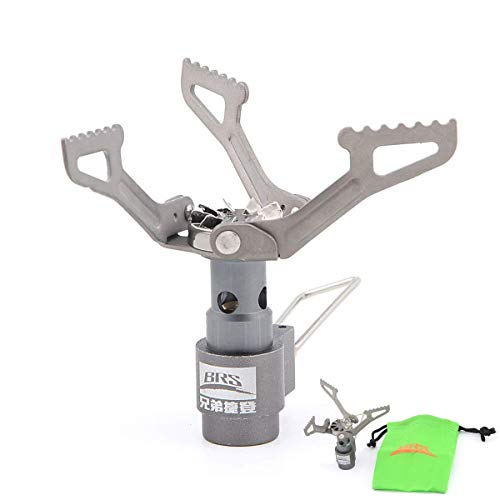

What the 3000T Gets Right
Most ultralight cooking is not really cooking. It is one of a few ways to boil water while camping, two cups at a time, poured into a freezer bag or a pouch meal.
That is the entire job this stove was built for, and at that job it is legitimately good. In calm air it brings a liter to a boil in about three minutes, and two cups for dinner go faster than you can dig out your food bag.
The packed size matters as much as the weight:
- Tiny kitchen: The stove disappears inside a 750 ml titanium pot next to a 110 g canister and a lighter, so the whole kitchen comes in around 12 ounces and takes up less room than a water bottle.
- Quick to pack: It cools fast enough to pack away within minutes of dinner.
- Cheap backup: At this price plenty of hikers buy a second one as a backup or a loaner.
Where It Falls Short
Wind
Wind is the big one. The flame column is narrow, there is no regulator, and there is no wind protection of any kind, so a steady breeze can double the boil time or stall it completely.
People who love this stove cook behind a rock, a pack, or their own body, every single time.
Pot Supports
The pot supports are the second complaint. The titanium arms are thin, and owners have reported them flexing or deforming under wide, heavy pots run at full blast.
Treat one liter and a solo meal as the ceiling. This is a stove for a small pot of water, not a two liter group dinner.
Cold Weather
Cold exposes the unregulated valve. Canister pressure drops as the fuel chills and output fades with it.
Plain butane stops vaporizing just below freezing, which is the heart of the whole butane vs propane camp stove question. The isobutane blend in threaded canisters buys you roughly 20 degrees Fahrenheit of margin, and a canister kept warm in your sleeping bag overnight buys a little more.
Simmer Control
Simmer control is the last gripe. The valve goes from off to blowtorch in about a quarter turn, and the concentrated flame scorches anything thicker than water, so real recipes are off the menu.
These two owner videos show the stove running in real conditions, wind problem included.
The Competition
The stoves people cross shop against the 3000T sit at the other end of the design spectrum. Both of these are integrated systems that trade grams for control and weather resistance, and both make sense for hikers the BRS does not fit.
Jetboil MiniMo Stove Cooking System

The MiniMo is what happens when simmer control is the priority.
- Simmer: Its regulated valve holds a low flame the BRS never will.
- Pot: The short wide pot is easy to actually eat out of.
- Weight: The whole system runs about 415 g.
If you cook real food on trail, it earns that weight. If all you do is boil water for pouch meals, the cheaper Jetboil Flash does that one job faster, and dedicated gram counters should skip both.
MSR WindBurner Personal Stove System

The WindBurner is the anti BRS. Its radiant burner sits fully enclosed under a locked-on pot, so the breeze that stalls a 3000T barely moves its boil time. That is why it shows up with guides and canoe trippers who cook in the open.
At 432 g for the one liter system it weighs as much as seventeen BRS stoves, and that is the whole trade in one sentence. Skip it if your routes have natural shelter and your pack weight budget is tight.
Habits That Keep a 3000T Working
A few field habits fix most of the complaints above.
- Block the wind with mass, not foil. Cook behind a rock or your pack. Never wrap a full windscreen around this or any upright canister stove, because the trapped heat cooks the canister sitting right under the burner.
- Do the fuel math before a long carry. Wide open, the 3000T pulls 140 g of gas an hour, which works out to roughly 7 or 8 g per liter boiled in calm air. Call it a dozen liters per 100 g canister on a good night and half that in wind and cold.
- Burn it at home first. Quality control on a 17 dollar stove is a lottery. Check that the arms click into place, the flame burns even and blue, and the valve does not hiss when closed. A bad unit costs a return label at home and a cold dinner on trail.
- Watch the flame color. Yellow and flickering means clogged burner ports, and the same gentle straightened paper clip method you would use to clean a camp stove at home works on the tiny titanium head too.
Verdict
The BRS 3000T earns its cult following honestly.
- Buy it if you are a solo hiker who boils water twice a day, cooks in sheltered spots, and counts both grams and dollars. Nothing else comes close at the price, and that is exactly who should buy it.
- Skip it if you cook for two or more, run exposed ridgelines in shoulder season, or want to simmer anything.
The MSR PocketRocket 2 costs about three times as much and fixes the stability and wind complaints for 48 extra grams, and that is the honest case against the BRS.
Most people who make that trade stop thinking about their stove. Most people who carry the 3000T keep bragging about theirs.


