

Table of Contents
Shop for binoculars online and you hit the same wall everyone hits. Two hundred listings, all wearing the same black rubber armor, all claiming HD glass and BaK-4 prisms, at prices anywhere from 25 dollars to 2,500.
The spec sheet will not tell you which pair is worth the money, because the things that separate cheap glass from good glass, coating quality and glass quality, never show up as a number.
This roundup narrows the field to five pairs that cover the usual buying cases:
- A cheap waterproof workhorse
- A starter pair for birders
- A budget 12×50 kit that comes with a tripod mount
- A hunting pair with real ED glass
- The pair I would tell most people to stretch for
One honest note before the picks: I have not run these five through a side by side field test, and nothing below pretends otherwise.
These calls come from the spec sheets, long term owner feedback, and enough hours behind similar glass to know which numbers matter and which are marketing.
Who Should Buy a Pair at All
Quick gut check first, because a surprising number of binoculars get bought, used twice, and left in a drawer.

- Birders get the most obvious payoff, since a bird you cannot see well is just a rustle in a bush.
- Hunters arguably use binoculars more than their rifle scope, and they should, because scanning a hillside through a scope means sweeping a loaded rifle across things you have not identified yet.
- Boaters, hikers, RV travelers, and anyone with a porch that faces something alive will use a pair more than they expect.
How Much to Spend
- Around 100 dollars: The practical floor for a pair you will not regret.
- Below that: Most binoculars have soft edges, dim evening performance, or alignment problems straight out of the box.
- Past 500 dollars: The gains are real but small, and casual users will not notice them.
Every pick below sits between those two lines.
The Five Picks at a Glance
The short version comes first, one line per pair, so a skimmer can pick a lane and jump straight to the matching review.
| Binocular | Best for | Key spec |
|---|---|---|
| Bushnell H2O 10×42 | All-around use in wet conditions | Sealed and nitrogen purged, 17 mm eye relief |
| Wingspan Optics Voyager 10×42 | First pair for a new birder | Fully multi-coated optics, lifetime warranty |
| Eccerd 12×50 | Tripod and phone-scope viewing on a budget | 12x power, phone adapter and tripod included |
| Carson 3D Series HD 10×42 | Hunting in low light | ED glass with dielectric coated prisms |
| Nikon Monarch 7 8×42 | Birding and hiking, best image of the group | 351 ft field of view at 1,000 yards |
The Reviews
Each pick below gets the same treatment, what it does well, what the spec sheet will not tell you, and who should skip it.
Bushnell H2O 10×42, the Waterproof Workhorse
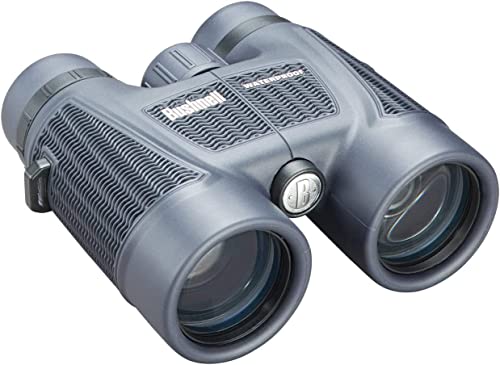
The H2O line is Bushnell’s answer to a simple fact, most cheap binoculars die from moisture, not misuse.
These are O-ring sealed and nitrogen purged, which means the inside cannot fog when you walk out of a warm cabin into a cold morning, and a dunk over the side of a canoe will not kill them.
For roughly 120 dollars you get:
- Magnification: 10x
- Objective: 42 mm
- Optics: BaK-4 prisms, multi-coated lenses
- Field of view: 305 feet at 1,000 yards
- Eye relief: 17 mm
The 17 mm of eye relief is the quiet win here, since budget pairs usually cut eye relief first and eyeglass wearers pay for it. The rubber armor grips well with wet hands, which matters more in a kayak than any optical spec.
The honest downside is the glass itself. It is standard optical glass, not the extra low dispersion type, so in the last half hour of usable light it goes dim and slightly washed out sooner than the Carson or the Nikon below.
At around 25 ounces it is not heavy, but it is no featherweight either.
- Buy it as the pair that lives in the boat, the truck door, or the pack lid.
- Skip it if most of your glassing happens at dawn and dusk, because low light is exactly where this price class gives up.
Wingspan Optics Voyager 10×42, a Starter Pair for Birders
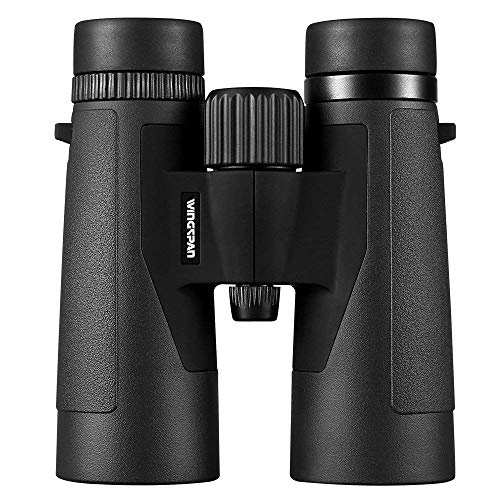
Wingspan is a small brand that sells almost entirely to birdwatchers, and the Voyager is their entry pair.
You get fully multi-coated optics and BaK-4 prisms in a light, compact roof prism body that carries all day without the strap digging into your neck.
At this price the Voyager and the Bushnell above are close to a coin flip on pure image quality, so the choice comes down to everything else:
- The Wingspan is lighter and comes with a lifetime warranty plus a 30 day money back window.
- The Bushnell answers with better eye relief and a tougher, grippier body.
The limits are the normal ones for a roof prism at this price. The center of the image is sharp, the outer edges go soft, and owners who wear glasses report the eye relief is tighter than they would like.
Skip it if you already suspect birding is about to become a serious habit, because you will outgrow it within a couple of seasons and end up buying the Nikon anyway.
Eccerd 12×50, the Budget Tripod Kit
The pitch here is more power for less money, and it needs an honest translation.
Handheld, 12x is mostly a downgrade from 10x, because almost nobody can hold 12x steady, and the extra reach gets eaten by shake. The rule of thumb worth trusting is that 10x is the handheld ceiling for most people.
What saves this kit is what comes in the box. You get a tripod adapter and a phone mount.
On a tripod the math flips. The shake disappears and 12x through a 50 mm objective becomes a pleasant fixed setup for a porch rail, a campsite table, or a truck window.
The phone mount turns it into a cheap way to photograph a nest or an osprey perch without buying a spotting scope.
Optically it is what a budget 50 mm pair is, decent color in full daylight and unimpressive at twilight. At a hefty 1.55 pounds, you will not want it on your neck all day.
- Skip it if you want one pair to hike with.
- Buy it if it will mostly live on a tripod.
Carson 3D Series HD 10×42, the Hunting Pick
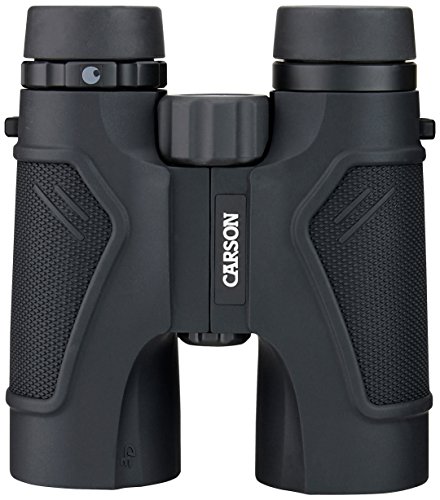
Carson puts ED glass and phase corrected, dielectric coated prisms into this pair at a price where the big names are still selling standard glass. That combination is not marketing fluff.
- ED glass controls the purple fringing you see around a deer’s outline against a bright field.
- Dielectric prism coatings keep the image bright in the last half hour of legal shooting light, which is precisely when whitetail move.
The body is clearly built for hunters, with:
- Molded thumb grooves
- Grippy rubber armor
- A Mossy Oak camo option
- Enough eye relief to work with shooting glasses
At about 1.4 pounds it rides fine in a chest harness. Carson also backs it with a no fault warranty, so a drop on a rock ridge is a repair, not a replacement bill.
Skip it if your binoculars mostly watch the backyard feeder. The Bushnell covers that job for half the money, and the Carson’s advantages only show up when the light gets bad and the details matter.
Nikon Monarch 7 8×42, the Best Glass Here
The instinct to buy the biggest number is the most expensive mistake in binoculars, and the Monarch 7 is the argument against it.
At 8x instead of 10x, the image holds steadier in your hands and the field of view opens up to 351 feet at 1,000 yards, the widest in this group.
A wide, steady view is how you actually get on a warbler in a tangle before it moves. It is why experienced birders lean toward 8×42 while catalog copy keeps pushing 10x.
There is also simple arithmetic in its favor. Exit pupil is the objective diameter divided by the magnification, and it decides how bright the image looks in dim light.
- This pair: 5.25 mm
- A 10×42: 4.2 mm
Your eyes notice that difference at dawn more than any coating buzzword.
Add the ED glass and phase corrected prisms and this is the best image in the roundup, full stop.
Nikon has since replaced the line with the Monarch M7, which means the original 7 regularly shows up discounted. At a discount it is the easiest recommendation on this page.
Skip it only if you glass wide open western country where the extra reach of a 10x earns its keep, in which case the Carson is your pick.
How to Read the Numbers Before You Buy
Every listing throws the same spec block at you. A few of those numbers decide whether you will like the pair, one is underrated, and the rest are mostly noise.

- Magnification and objective size. A 10×42 magnifies ten times through a 42 mm front lens. More power means more detail, but also more shake and a narrower view.
- Exit pupil, the underrated one. Divide the objective by the magnification. Anything near 5 mm stays bright at dawn and dusk, anything near 3 mm is a daylight-only pair.
- Field of view. Measured in feet at 1,000 yards. Wider means you find the bird or the buck faster, and it shrinks as magnification climbs.
- Eye relief. The distance your eye can sit from the lens and still see the full image. With glasses, hold out for 16 mm or more.
- Prisms and coatings. Roof prisms make a slimmer body, Porro prisms give more brightness per dollar. On coatings, “fully multi-coated” is the phrase that matters, and anything less is a step down.
- Sealing. O-ring sealed plus nitrogen or argon purged means rain and temperature swings will not fog the inside.
Frequently Asked Questions
Three questions come up over and over from first time buyers, so the plain answers are below.

How do binoculars work?
A binocular is two small telescopes fixed side by side, with a pair of prisms in each barrel. The objective lenses flip the incoming image upside down, and the prisms fold the light path and turn the image right side up again.
- Roof prism models run the light in a nearly straight line for a slim body.
- Porro prism models offset the barrels, which is why old style binoculars have that stepped shape.
What do numbers like 10×42 mean?
The first number is magnification, the second is the diameter of the front lens in millimeters.
So a 10×42 makes things look ten times closer and gathers light through a 42 mm lens. A 10×25 has the same power through a much smaller lens, which is why pocket pairs go dim at dusk.
The format is the same across every brand.
How much magnification do I need?
- Most outdoor use: 8x or 10x covers it, and 8x is the safer call because it is easier to hold steady.
- Long open country: Hunters who glass it lean toward 10x.
- Above 10x: Anything that strong really wants a tripod.
- Concerts and stadiums: A small 5x to 7x pair is plenty, and it fits in a jacket pocket.


